

Before we get into it, I’m doing a live event March 5 to talk publicly for the first time about my cancer diagnosis last year. Joining me is Erica Wells of MagView, who will share innovations in cancer imaging (since 5 MRIs missed one of my tumors) + practical advice for how to become a self-advocate. RSVP to be notified when we go live, and get the recording.
Just for Fun
775,000 followers and 13 comments
You already know I preach that founders should build a personal brand before they exit, that fear of talking about ourselves stops us, and that templating our content will kill society as a whole. You may not know that over $1.8M of our revenue at Backroom has come from my LinkedIn account alone, and that does not include brand partnerships, speaking opportunities, or all the new friends I’ve made along the way (the real prize! jk it’s money. Money is the prize).
I built a social strategy for a client last year—a mid-market cybersecurity company that had just gone through a six-company rollup, new name, new brand, the whole thing, and part of the engagement was figuring out how they should show up on LinkedIn. Which meant I spent a frankly embarrassing number of hours looking at how the biggest brands in their space were doing it, what was working, and what was just expensive noise.
And I found something that should make every company currently paying a social media manager to post branded graphics three times a week want to throw their laptop into a river.
CrowdStrike, with 775,000 LinkedIn followers, massive marketing budget, legitimate best-in-class cybersecurity brand, posted their Q3 earnings on their company page. Beautiful graphic, strong numbers, $4 billion in ending ARR, chef’s kiss.
Their CEO, George Kurtz, posted the exact same content from his personal account the same day, and, well…:
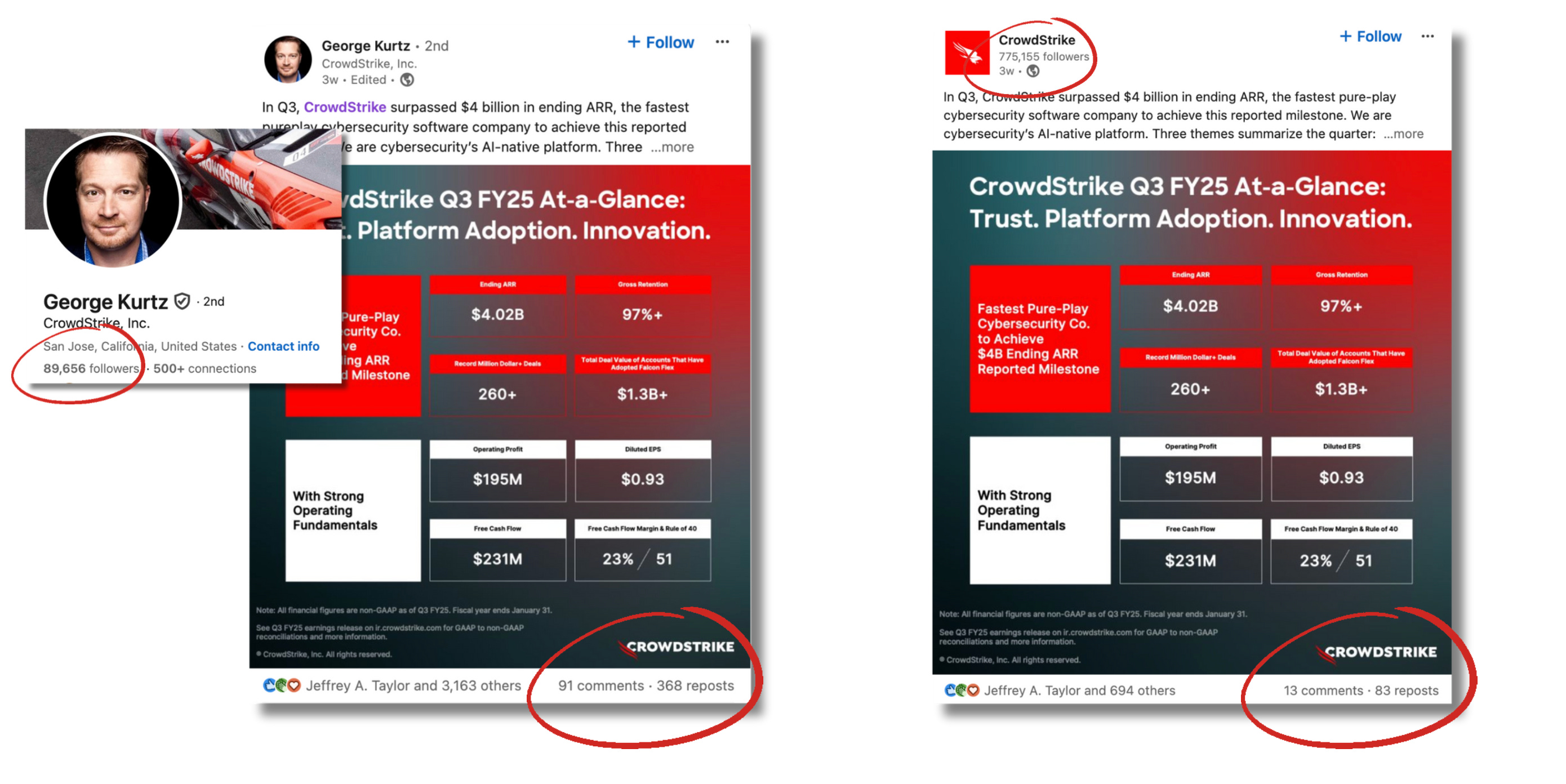
The company page got about 700 reactions and 13 comments. George got over 3,000 reactions, 91 comments, and 368 reposts.
Sit with that for a second because the implications here are brutal. A company with three-quarters of a million followers posted the same thing as one guy with 90,000 and the guy got 4-5x engagement.
I’ve been building brands since Twitter had a Fail Whale and the last three years have fundamentally changed the math on the role social plays in brand equity. The company page used to be the center of gravity. You built the brand, you published from the brand, you measured the brand’s metrics, and the humans behind it were secondary characters in someone else’s story. That’s over. Not because company pages are useless (they still matter, please give them love), but because the algorithm, how we treat corporate culture, and the way people make purchasing and investment decisions have all pivoted toward people.
When I was building that client’s social strategy, I looked at brands in the B2B and cybersecurity space, and every single one that was actually growing follower count, driving engagement, and converting attention into pipeline had the same thing in common: they were investing in multi-dimensional executive-led content.
Palo Alto Networks has Nikesh Arora, and he isn’t just posting quarterly earnings from his account, he’s in and of the community. He engages with other founders’ posts, reposts his team’s content, riffs on industry trends in a way that sounds like a person. The corporate page does LinkedIn Lives in multiple languages (which is smart), but Nikesh is the reason anyone’s paying attention in the first place.
Aha! has Brian de Haaff, who’s been on LinkedIn for about a decade at this point, posting leadership content that sneakily creates use cases for their software without feeling pitch-slappy. He’s not selling, he’s just thinking out loud in public. And every time he does, it drives traffic to the product page without a single “link in the comments.”
Apollo.io went a different direction entirely and turned their employees into the content engine. Their team members take over the brand page, teach in videos, cross-promote with external creators including this 12/10 sales course with Samantha McKenna. They were one of the first brands to invest in EGC.
And then there are the companies spending real money on gorgeous, on-brand, strategically planned content that goes out to hundreds of thousands of followers and gets 13 comments.
I talk to execs, founders, and investors every week- who tell me some version of the same thing:
“I know I should be doing more on LinkedIn, but I don’t know what to say.” And then they go on to tell the most interesting story I’ve heard in my life.
Every time I hear it, I want to reach through the screen, because you already know what to say. You say it in board meetings. You say it in pitch decks. You say it in the group chat with your three closest peers when someone asks a dumb question and you go on a twelve-text rant about what’s actually happening in your industry. And clearly, you say it to me in a random call on a Tuesday.
You have opinions. You have a thesis. You say smart, specific shit in board meetings and pitch decks and the group chat with your peers all the time. The problem isn’t that you don’t have content, it’s that you haven’t built the infrastructure to get it out of your head and onto a platform on a regular basis.
When someone says “build a personal brand,” I know it sounds like they’re asking you to become a content creator. Pointing at text on a screen while a trending audio plays. (It’s not that. Please don’t do that. Don’t do a dance. Stop showing your NRF photos.)
What it actually looks like: figure out the three or four things you have a right to talk about. Record yourself talking about them like a normal person, pretend you’re talking to a friend. Then, someone turns those into posts and clips and carousels. You show up two to three times a week. Let the algorithm do what it was designed to do: amplify people over brands.
“Great, that works for CEOs with 90,000 followers. I have 800 and my last post got four likes, two of which were my employees.”
The math actually works better when you’re smaller. A founder with 5,000 followers posting something with a real point of view will get a higher engagement rate than a company page with 50,000 followers posting safe, approved-by-legal content that offends no one and inspires no one. The algorithm rewards engagement rate, not volume. And the people who matter to your business — your LPs, your clients, your future hires, your competitors — are already on the platform every day. They’re just not seeing your company page because the algorithm buried it under posts from humans who actually said something.
The people I work with who build real personal brands don’t do it by being “thought leaders” (please, we would never). They do it by being visible about what they believe and why it matters, in their own voice, on a regular basis. No growth hacks. No engagement pods. No “comment ‘FRAMEWORK’ and I’ll DM you my 47-slide deck.” (woof). Just a regular old person with a strong POV who cares about their mission and their audience.
Behind the paywall this week:
If you’ve been meaning to “get more active on LinkedIn” for the past year and a half and you keep pushing it to next quarter, I’m showing you exactly what it looks like to build a personal brand content engine from scratch.
Let’s get into it.